Darkest Legal Window Tint in NSW: Laws, Limits & Fines
28 January 2026 · 12 min read · Solarblock
35%. That's the minimum visible light transmission for front side windows in NSW — and it's the number that matters most if you're shopping for window tint.
Everything behind the driver can go significantly darker — down to 20% VLT on rear side windows and the rear windscreen. But the front sides and windscreen have firmer limits, and getting caught outside them means a fine, a defect notice, and the cost of having the film stripped and replaced.
Here's exactly what's legal, what's not, and why the darkest tint isn't necessarily the best tint.
NSW Window Tint Laws at a Glance
| Window Position | Minimum VLT | Notes |
|---|---|---|
| Windscreen | 70% VLT minimum | Tinted band permitted at top — no more than 10% of height or wiper sweep arc, whichever is greater. No other film below the band. |
| Front side windows | 35% VLT | Must allow at least 35% of visible light through |
| Rear side windows | 20% VLT | Most passenger vehicles. Vehicles with only a driver-side mirror: 35% VLT. |
| Rear windscreen | 20% VLT | Most passenger vehicles. Vehicles with only a driver-side mirror: 35% VLT. |
| Film reflectance | 10% max | Film must not have a reflectance of more than 10% |
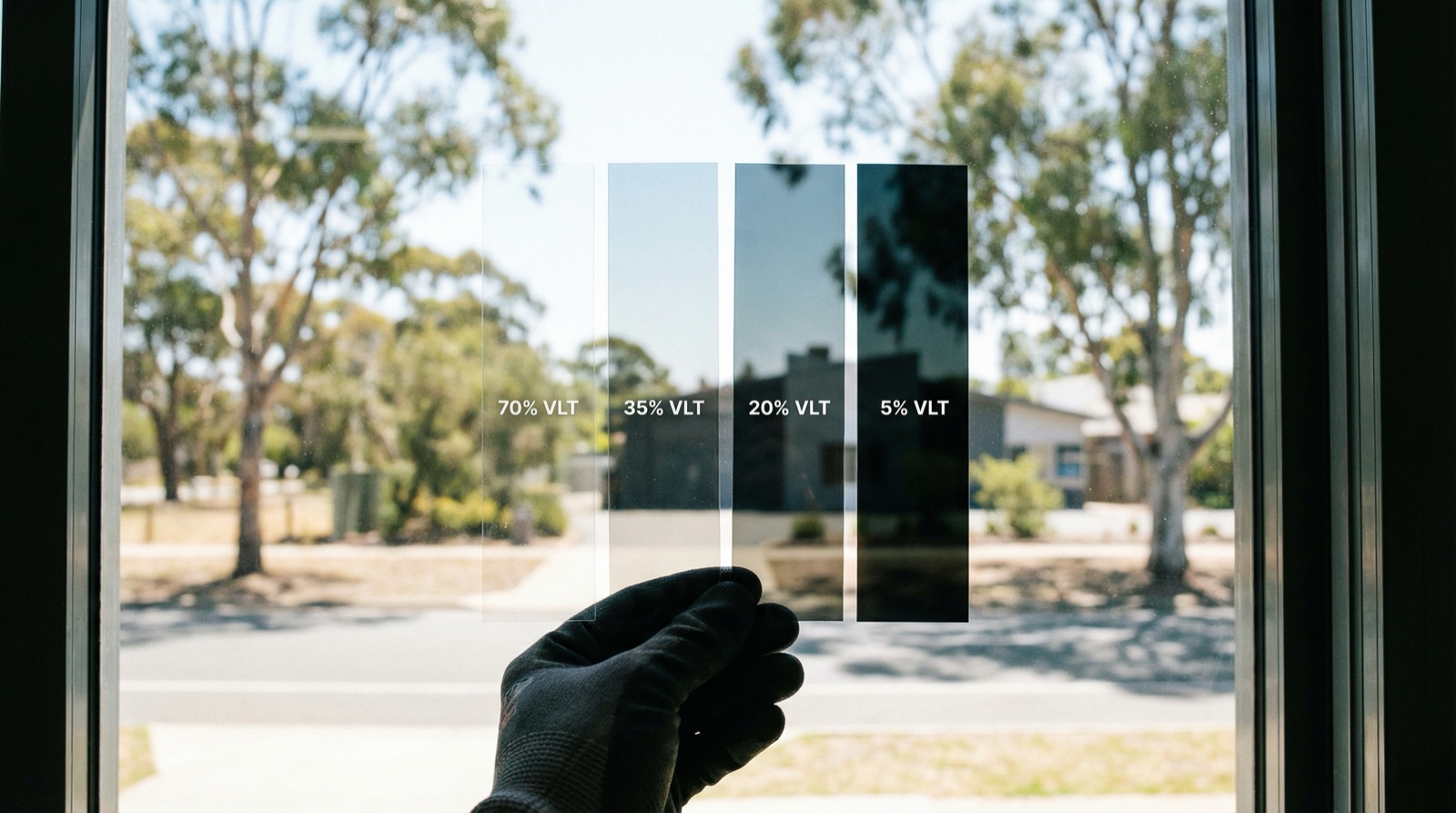
These limits are set by the NSW Road Transport (Vehicle Registration) Regulation 2017. They apply to all registered vehicles in NSW, regardless of whether the tint was applied here or interstate.
The VLT figure refers to the total light transmission through the glass and the film combined. Factory glass already blocks some light (typically around 70–75% VLT on front windows), so the film you add needs to account for that. A professional installer can measure the combined VLT after application to confirm compliance.
What Is VLT (Visible Light Transmission)?
VLT is the percentage of visible light that passes through the glass and any applied film. A higher number means more light gets through — 70% VLT is nearly clear, 5% VLT is almost opaque.
The measurement isn't about how dark the tint looks from outside. It's about how much light reaches the interior. Two films can look similar to the eye but measure differently on a VLT meter — which is exactly the instrument police and inspectors use.
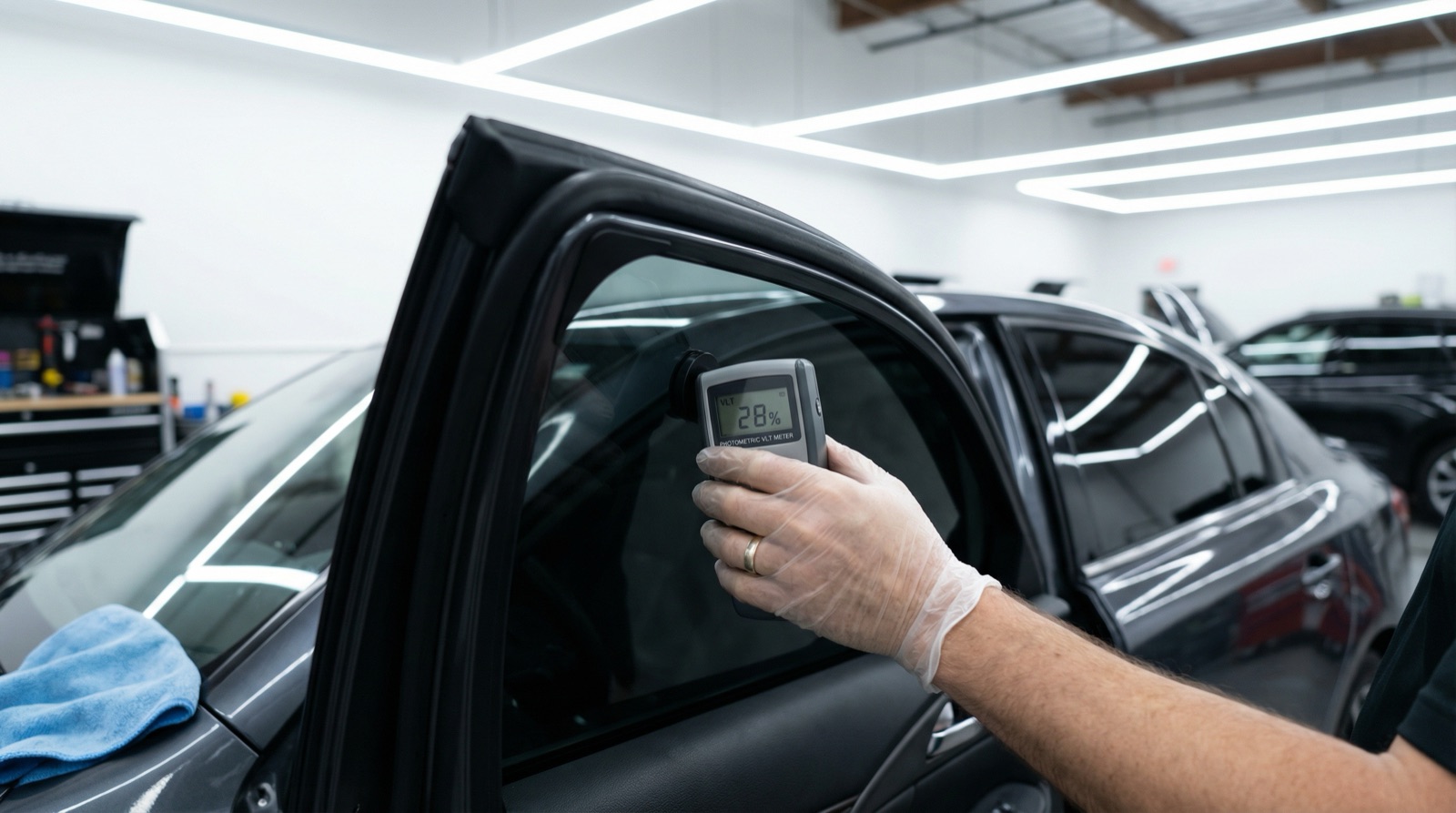
VLT is measured with a photometric device placed against the glass. There's no judgement call or visual estimate involved. Either the combined reading (glass plus film) meets 35% or it doesn't.
Darkest Legal Tint for Front Side Windows
The legal minimum for front side windows in NSW is 35% VLT. That means at least 35% of visible light must pass through the glass-and-film combination.
In practice, most quality tint films are labelled by their nominal VLT — a "35% film" applied to factory glass (which typically sits around 72–75% VLT) will produce a combined reading close to 25–26% VLT. That's technically over the limit.
This is why professional installers don't just slap a "35% film" on and assume it's legal. They either use a slightly lighter film (40% nominal) to ensure the combined reading stays above 35%, or they measure the factory glass first and calculate the right film shade. The combined figure is what matters at an inspection, not the film's rated VLT alone.
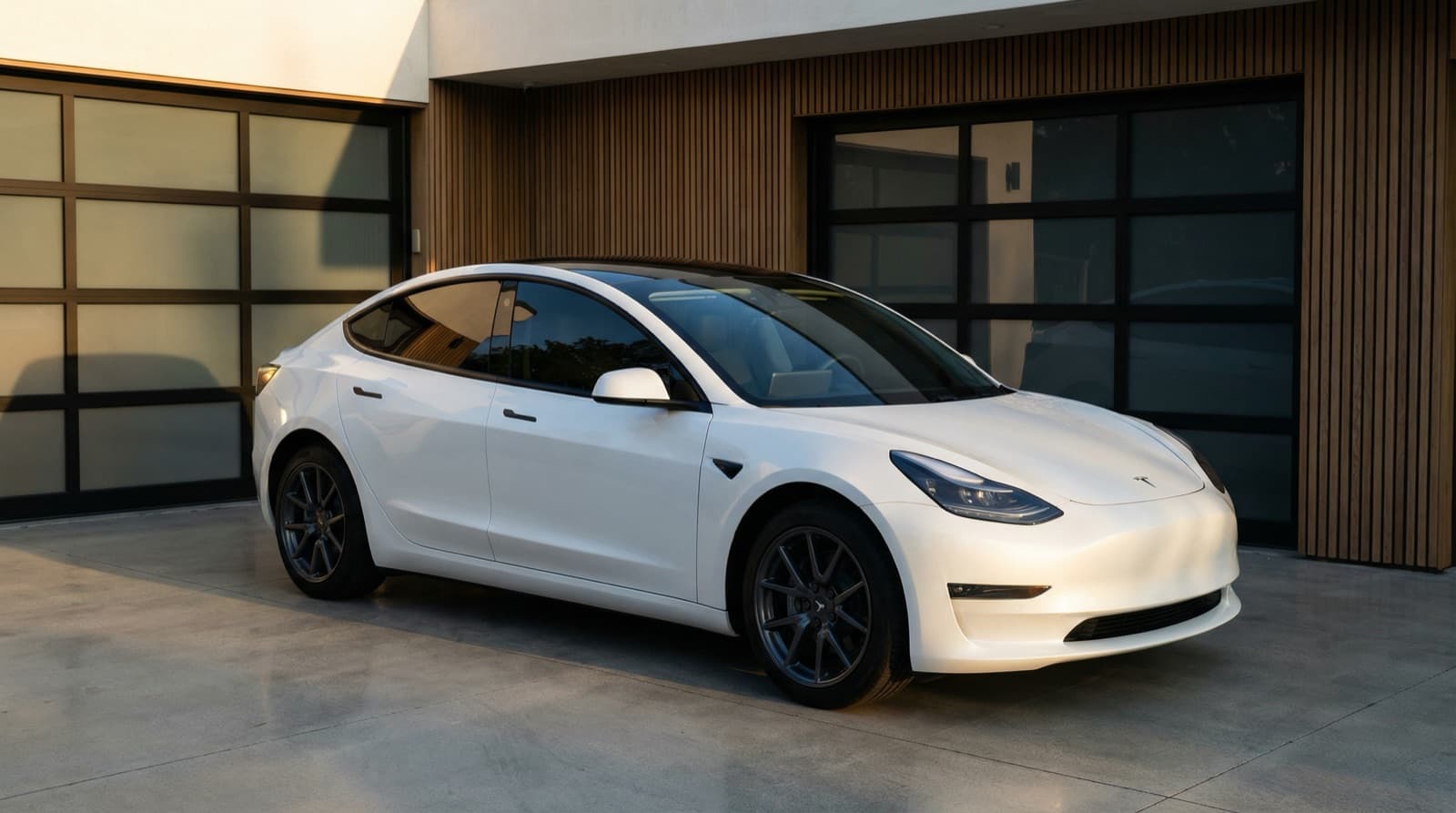
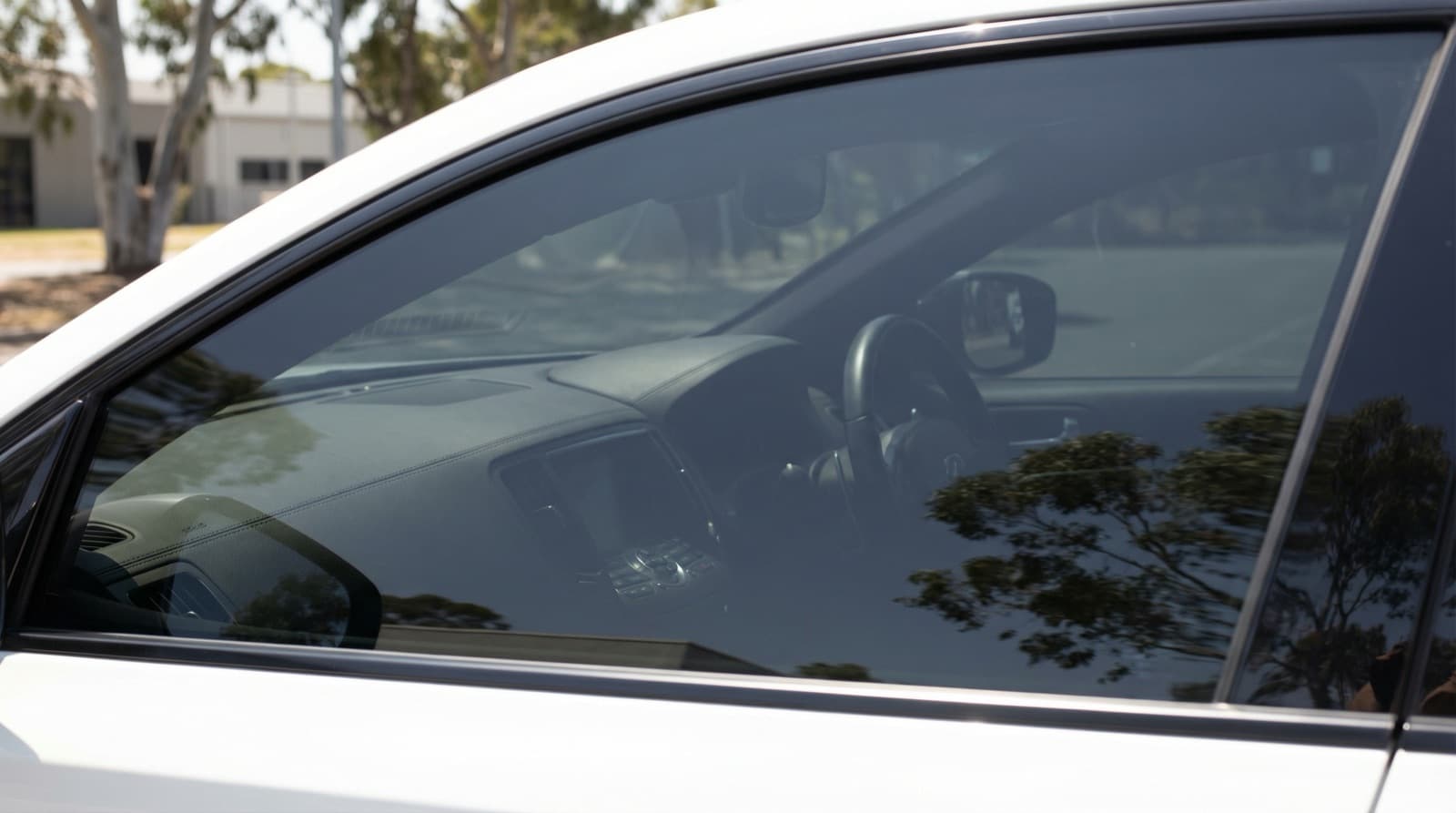
A well-chosen ceramic film at legal 35% VLT still looks noticeably tinted. It's not clear glass — there's a visible darkening that reduces glare and adds privacy from outside during daylight. At night, visibility from inside is largely unaffected.
Darkest Legal Tint for Rear Side Windows and Rear Windscreen
The minimum VLT for rear side windows and the rear windscreen in NSW is 20%. That's significantly darker than the front — dark enough for strong privacy and a blacked-out look from the outside. This applies to most passenger cars (any vehicle with both a driver and passenger-side mirror).
If your vehicle only has a driver-side mirror, the rear windows must also meet 35% VLT — the same as the fronts. Commercial vehicles and trucks have no minimum VLT specified for windows rearward of the driver.
Most customers choose 20% VLT on the rears, which sits right at the legal limit and gives an excellent balance of privacy and visibility. It's dark enough to look fully tinted from outside, while still allowing you to see out comfortably — including at night and when reversing.
Our recommendation for most vehicles: 35% on the fronts, 20% on the rears. This gives a clean, graduated look without creating a stark contrast between front and back, and you retain enough rear visibility for safe driving. If you're looking for professional window tinting in Sydney, we can walk you through the VLT options at our Hornsby and Gosford workshops.
Want legal tint that actually blocks heat?
Ceramic film, professional fit, VLT verification available. Hornsby & Gosford workshops.
Get NSW-Legal Window TintingOr call: 0422 976 875
Windscreen Tint Rules
The windscreen has the strictest rules. The glass itself must be rated at 70% VLT or higher — most factory windscreens sit well above this. The only aftermarket film permitted is a tinted or opaque band at the top of the windscreen.
The band can cover no more than 10% of the windscreen height, or extend to the swept arc of the wiper blades, whichever is greater. Most customers go with a subtle gradient that transitions from dark to clear. A well-fitted visor strip reduces sun glare at the top of the windscreen where the sun visor doesn't quite cover.
Anything below the band must remain free of aftermarket film. Spray-on tinting is also not permitted on any window.
Clear ceramic films that block heat without darkening the glass exist, but NSW regulations don't currently provide a general exemption for them on windscreens. The rule is straightforward: no film below the visor band.
Is 5% Tint Legal in NSW?
On standard passenger vehicles — no. The minimum VLT for rear windows in NSW is 20%, and 5% sits well below that. On the front side windows, 5% is also illegal — the minimum there is 35%.
Commercial vehicles and trucks have no minimum VLT for windows rearward of the driver, so they can go darker behind the driver's position. Passenger cars with only a driver-side mirror must still meet 35% VLT on all windows including rears.
This is the most common question we get. NSW draws a clear line: the driver needs adequate visibility through all windows, with tighter limits on the front and slightly more latitude on the rear.
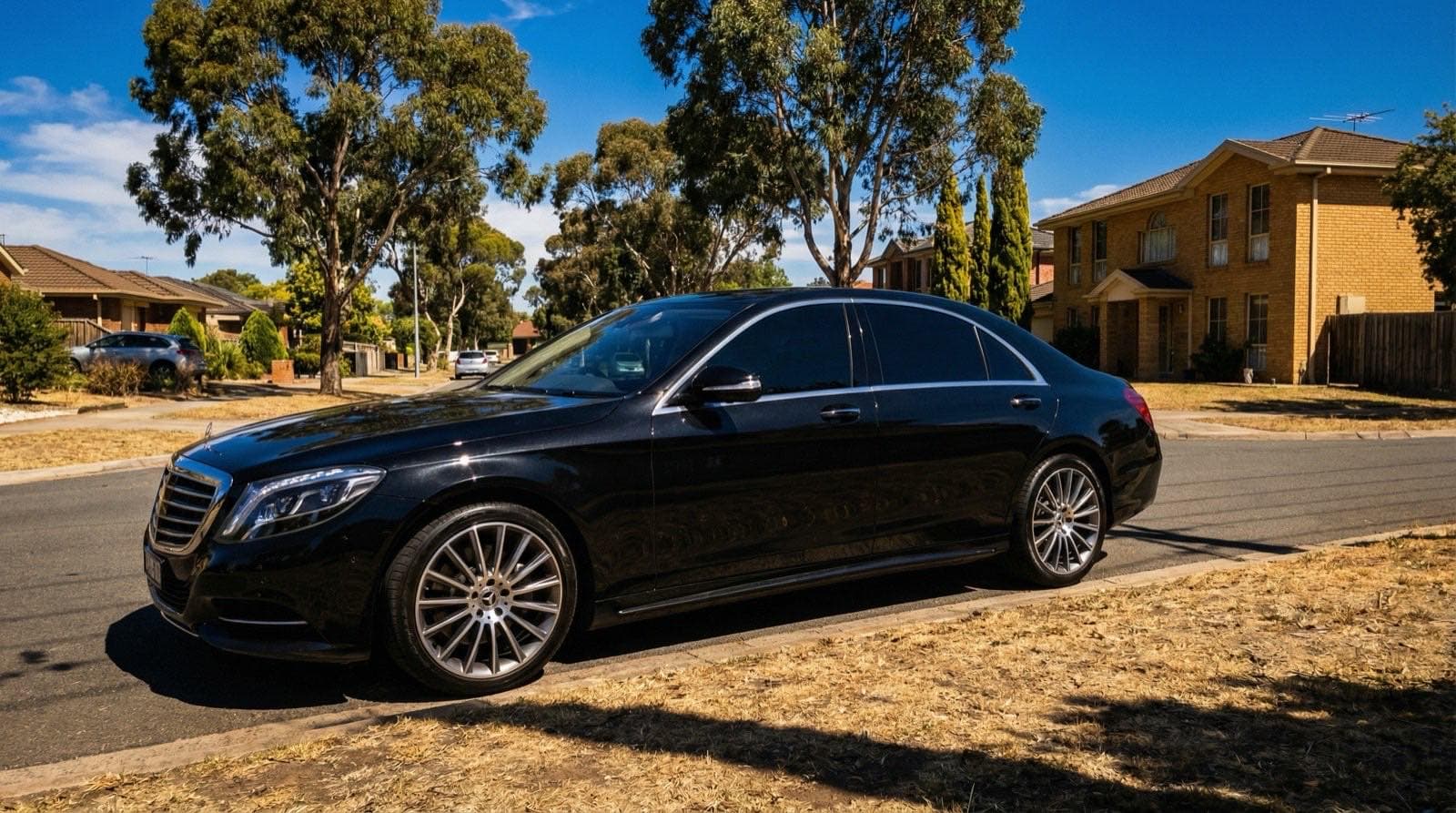
If you want the darkest possible look while staying legal on a standard passenger vehicle, the combination is 35% VLT on the front sides and 20% VLT on the rears. Many factory SUVs already come with dark rear privacy glass around 20% VLT, so the look isn't unusual.
Is Chameleon Tint Legal in Australia?
Chameleon tint — sometimes called colour-shifting or iridescent film — changes colour depending on the viewing angle. It's become popular for the look, but legality depends on one thing: the VLT reading after application.
If a chameleon film on the front side windows produces a combined VLT of 35% or higher, it's legal in NSW. If it drops below that threshold at any angle, it's not.
The complication is that chameleon films can read differently depending on where the VLT meter is placed, because the optical properties shift across the surface. Some chameleon films are marketed at 70% VLT but measure lower once applied. An inspector uses a photometric meter — if the reading is under 35% at the measurement point, you'll get a defect notice regardless of what the product packaging says.
If you're set on chameleon film, have a professional installer measure the actual VLT after application. Get a reading you're confident in before driving away.
Fines and Defect Notices for Illegal Tint
Getting caught with illegal tint in NSW follows a predictable process.
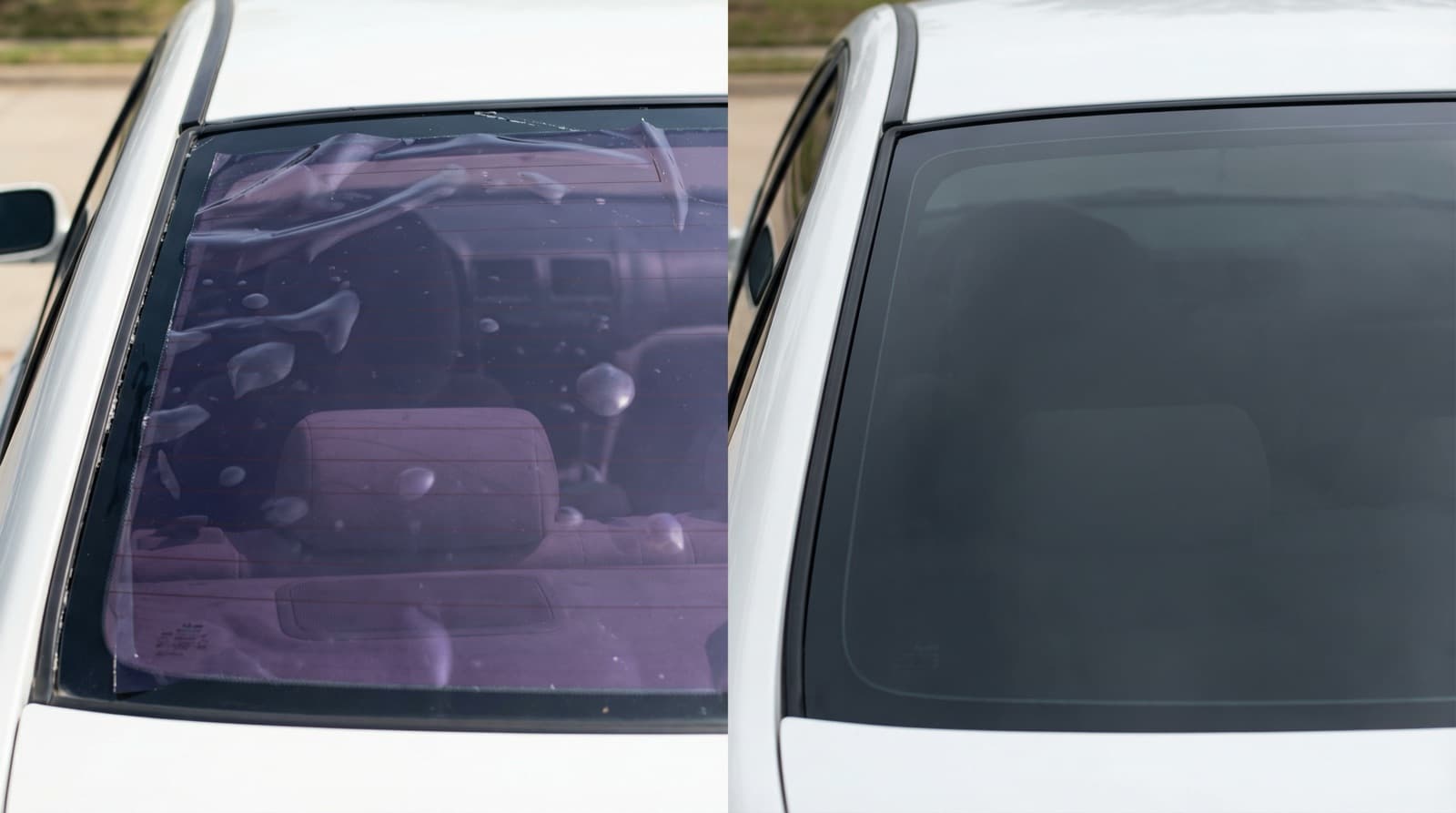
Step 1: The defect notice. A police officer or authorised inspector issues a yellow defect notice for the vehicle. This identifies the tint as non-compliant and gives you a timeframe (usually 14 days) to have the film removed or replaced with a legal alternative.
Step 2: The fine. A defective vehicle penalty in NSW carries a fine of several hundred dollars (the exact amount is updated annually — check the current NSW penalty schedule for the latest figure). The fine applies at the time of the defect notice — you pay it regardless of whether you fix the tint afterward.
Step 3: Clearance inspection. Once you've had the illegal tint removed or replaced, you take the vehicle to an authorised inspection station. They verify the tint is now compliant, sign off on the defect notice, and clear the vehicle.
What else can get you defected? It's not just VLT. Film with a reflectance above 10% — mirror-like or highly reflective tint — is also illegal. So is spray-on tinting and any damaged tint that impairs the driver's visibility.
What triggers an inspection? Random breath testing (RBT) stops are the most common situation. The officer sees the tint, pulls out a VLT meter, and measures. Highway patrol vehicles also carry meters. Registration inspections (pink slips and blue slips) include a tint check as standard.
The total cost of illegal tint — once you factor in the fine, the cost of removal, the cost of replacement legal tint, and the inspection clearance — easily exceeds $1,000. All to get darker front windows that, with the right film, you didn't need in the first place.
Medical Exemptions
NSW does allow medical exemptions for window tint that exceeds standard limits. The process requires:
- A letter from a specialist (dermatologist or ophthalmologist, not a GP) confirming the medical need for additional UV or light protection
- An application to Transport for NSW with the specialist letter
- Approval from Transport for NSW, which specifies exactly which windows may exceed standard VLT limits and by how much
Medical exemptions may be granted for conditions like lupus, severe photosensitivity, and certain skin cancer risks. They're not blanket approvals for 5% tint on every window — the exemption is specific to the medical need documented by the specialist.
If you have a medical exemption, carry a copy in the vehicle. Police and inspectors need to see it at the roadside to verify that your exemption has been granted.
How to Stay Legal — Work With a Professional Installer
The simplest way to stay legal is to have your tint installed by a professional who measures VLT after application — not one who guesses based on the film's rated shade.
A customer came in wanting 5% on all windows. We walked him through the VLT readings and showed him that a ceramic film at legal 35% actually rejected more heat than the 5% dyed film he'd seen online. He went with 35% ceramic on the fronts, 20% on the rears — legal, cooler cabin, and no risk of a defect notice at the next RBT.
This is the point most people miss: darkness and heat rejection are not the same thing. A high-grade ceramic film at 35% VLT blocks 60%+ of infrared heat. A cheap dyed film at 5% VLT blocks maybe 10–15%. The ceramic film at legal darkness keeps your cabin cooler than the illegal dark film does.
If heat is your concern — and for most people in Sydney, it should be — the answer isn't darker film. It's better film. Ceramic tint at legal VLT levels outperforms every other film type at any darkness level. You get superior heat rejection, 99% UV protection, no signal interference, and zero legal risk.
We fit ceramic window tint at our Hornsby and Gosford workshops. We use quality ceramic film at known VLT ratings, and we can verify the combined reading with a photometric meter if you want confirmation before you drive away. No guesswork, no grey areas, no defect notices.
For the full breakdown on ceramic vs regular tint — including how ceramic film achieves better heat rejection at lighter shades — read our ceramic window tint guide.
Frequently Asked Questions
What is the darkest legal window tint in NSW?
Front side windows must allow at least 35% VLT. Rear side windows and rear windscreen must allow at least 20% VLT. The windscreen must maintain at least 70% VLT, with only a tinted band permitted at the top — no more than 10% of the height or the wiper sweep arc, whichever is greater. Film reflectance must not exceed 10%. These limits apply to the combined reading of glass plus film.
Is 5% tint legal in NSW?
No. On standard passenger vehicles, 5% tint is illegal on all windows. The minimum VLT is 35% on front sides and 20% on rears. Commercial vehicles and trucks have no minimum VLT for windows rearward of the driver. Passenger cars with only a driver-side mirror must meet 35% VLT on all windows including rears.
What is the fine for illegal window tint in NSW?
Illegal tint results in a defect notice and a fine of several hundred dollars. You then have 14 days to remove or replace the tint and pass a clearance inspection. Total cost including removal, replacement tint, and the inspection easily exceeds $1,000.
Is chameleon tint legal in NSW?
Chameleon tint is legal only if the combined VLT reading meets the minimum — 35% on front side windows. The VLT must pass at the measurement point using a photometric meter, regardless of the product's rated VLT.