Tesla Window Tinting & PPF: What Sydney Tesla Owners Need to Know
10 February 2026 · 10 min read · Solarblock
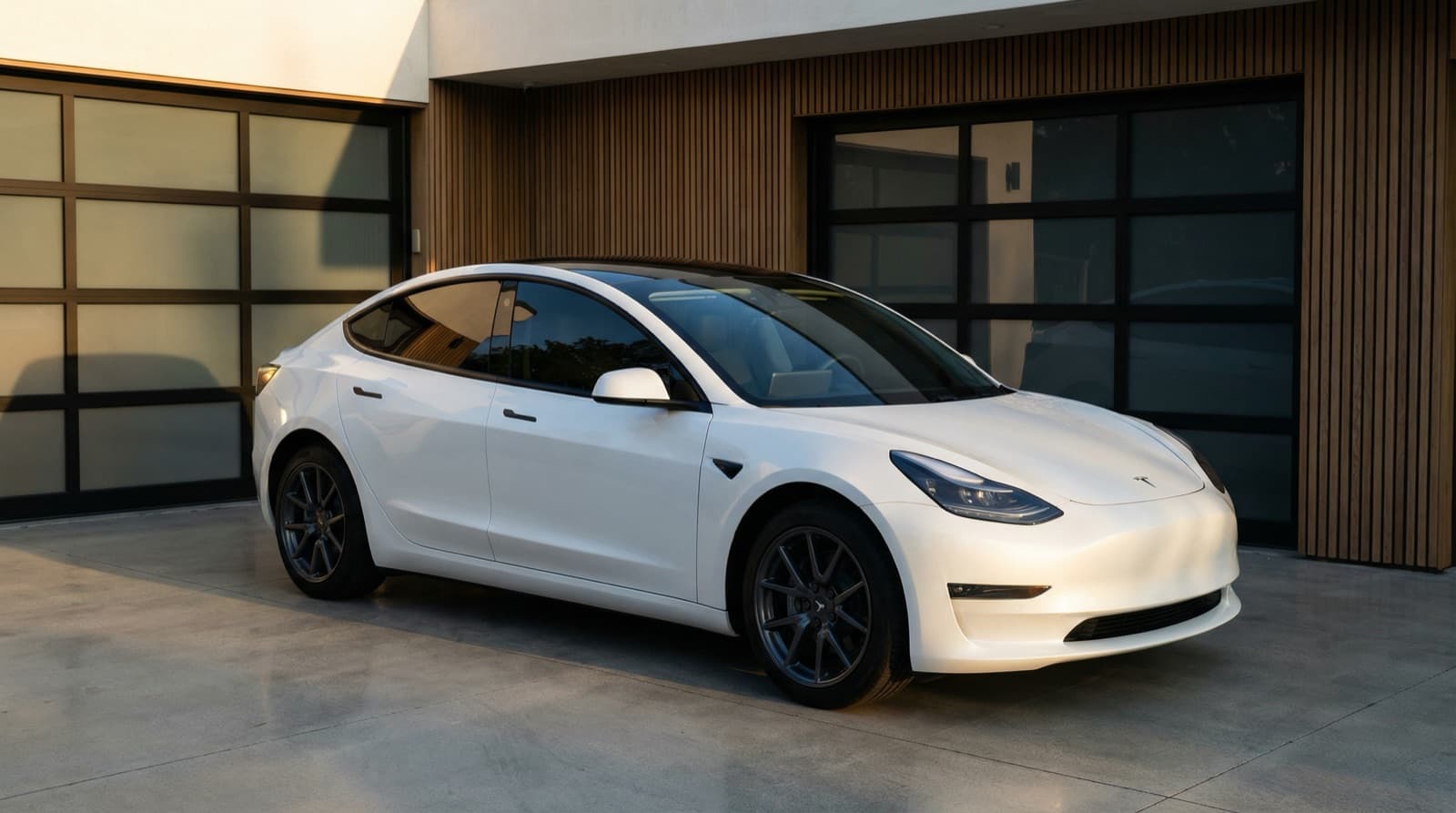
You pick up your new Model 3, drive it home, park it in the driveway, and within twenty minutes the cabin is an oven. The glass roof that looked so good in the showroom is now a massive solar panel aimed directly at you and your passengers. You run the automatic air conditioning up, which hammers the range, and you start wondering how anyone in Sydney drives one of these without window tint.
They shouldn't! Tesla's design creates two specific problems that window tinting and PPF solve better than any other aftermarket protection.
Why Tesla Owners Need Window Tinting
Every Tesla model ships with an expansive glass roof. The Model 3 and Model Y use a single-piece glass panel that stretches from the windscreen header to the rear tailgate area. It is beautiful, light, and dramatic. It also lets in a massive amount of solar energy.
Tesla's factory glass includes some IR rejection, but in Australian conditions it's not enough. Cabin temperatures in a parked Tesla with untinted glass can climb 15°C or more above ambient on a Sydney summer day. The air conditioning system works harder to compensate, which directly reduces driving range — the one thing every EV owner watches.
UV is the other factor. The glass roof exposes every occupant to sustained UV radiation during every drive. Factory glass blocks some UV, but ceramic aftermarket film pushes that to 99% across both UVA and UVB wavelengths. For a car where the roof is essentially a window, that's a practical upgrade, not a cosmetic one.
Best Window Tint for Tesla
Ceramic window tint is a very sensible option for a Tesla. It's why Tesla's are one of the most popular cars we tint in our Hornsby shop.
Metallic-based tint films contain metal particles. In certain circumstances they can interfere with radio frequencies. On most cars, that means degraded GPS and phone signal. If a Tesla's antenna is covered (its location depends on model), it means potential interference with:
- Phone key — the Bluetooth connection between your phone and the car that unlocks it and allows you to drive
- Cellular and Wi-Fi connectivity — over-the-air updates, streaming, and real-time traffic data
- GPS navigation — routing and real-time traffic data
- Toll tags — E-Tag and Linkt readers on Sydney's motorways and the M1
Some installers still fit metallic film. It's cheaper, and on a regular car the signal interference is a minor annoyance. On a Tesla, it can stop the phone key from working reliably, degrade Autopilot performance, and make toll tags miss reads. It's a mistake.
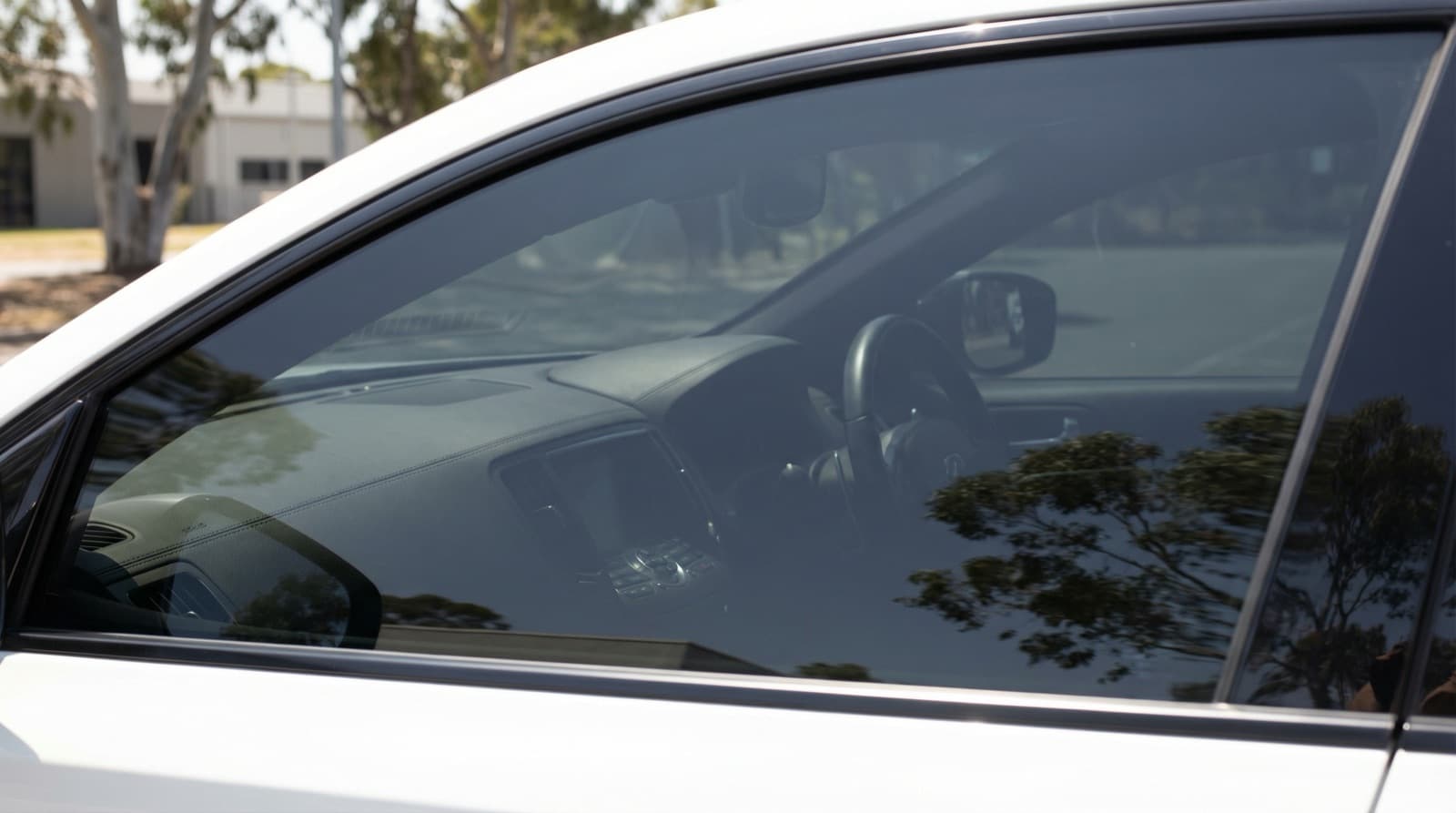
Ceramic tint uses nano-ceramic particles instead of metal. Zero signal interference. Heat rejection of 45–80% depending on the film grade. 99% UV blocking. And it's available in the same range of VLT shades as any other film type, so you don't sacrifice darkness for the ceramic benefit.
For the front side windows, NSW law requires a minimum of 35% VLT. A quality ceramic film at 35% will reject more heat than a cheap 5% dyed film — darkness and heat rejection are different measurements entirely.
Tesla owner? Let's sort your tint and PPF.
Electric vehicles — Tesla, BYD, and others — are the most common cars we work on. Hornsby & Gosford workshops.
Get a Tesla Protection QuoteOr call: 0422 976 875
Tesla Glass Roof Tinting — What to Know
The glass roof is the reason most Tesla owners come to us. It's also one of the most technically demanding window to tint on any car we work on.
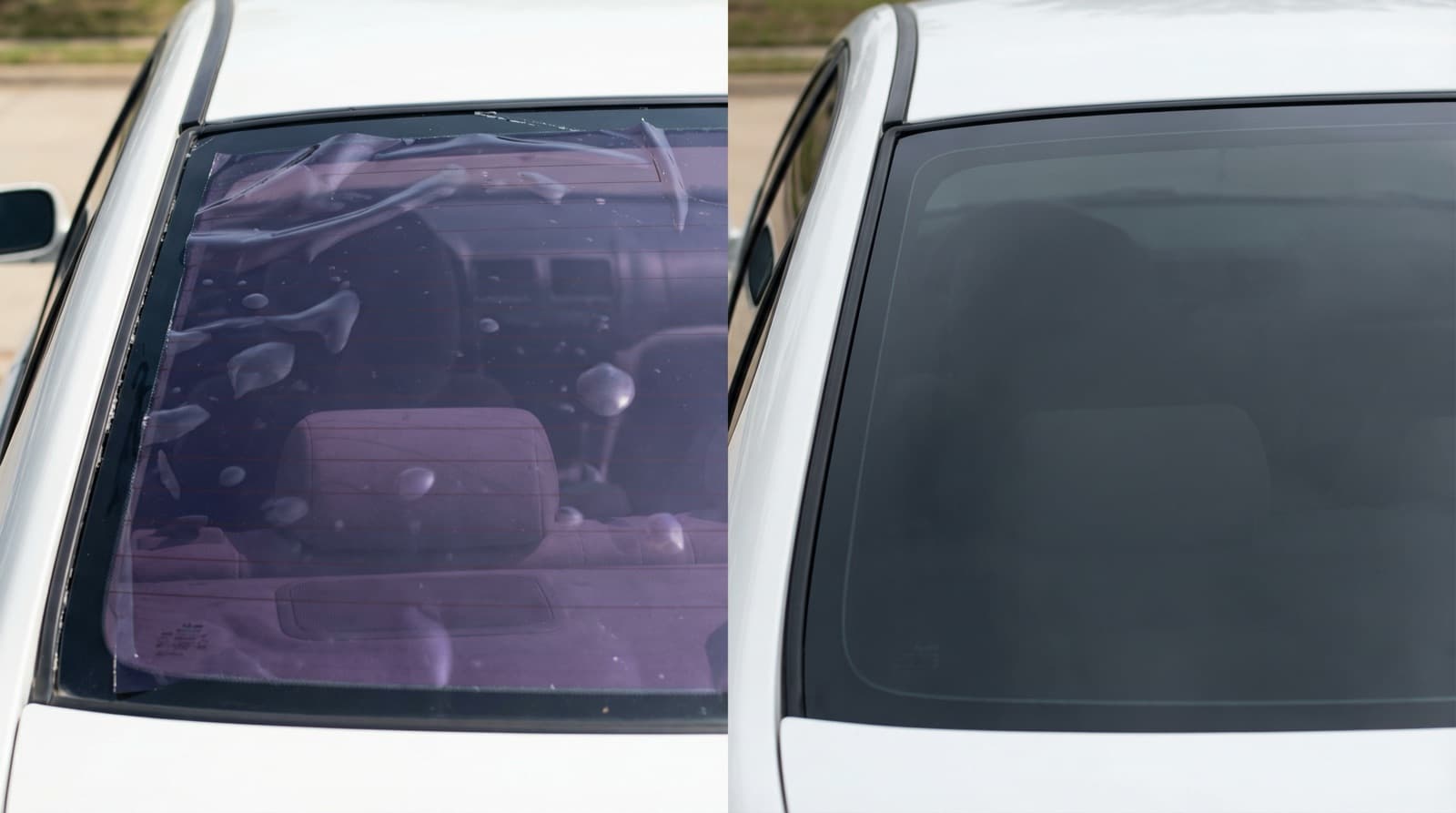
Single-piece design. The Model 3 and Model Y roof is one continuous panel with no frame break in the middle. That means one large piece of film, applied in one pass, with no margin for repositioning once the film is placed. A bubble, crease, or misalignment on a panel this size is visible from every seat in the car.
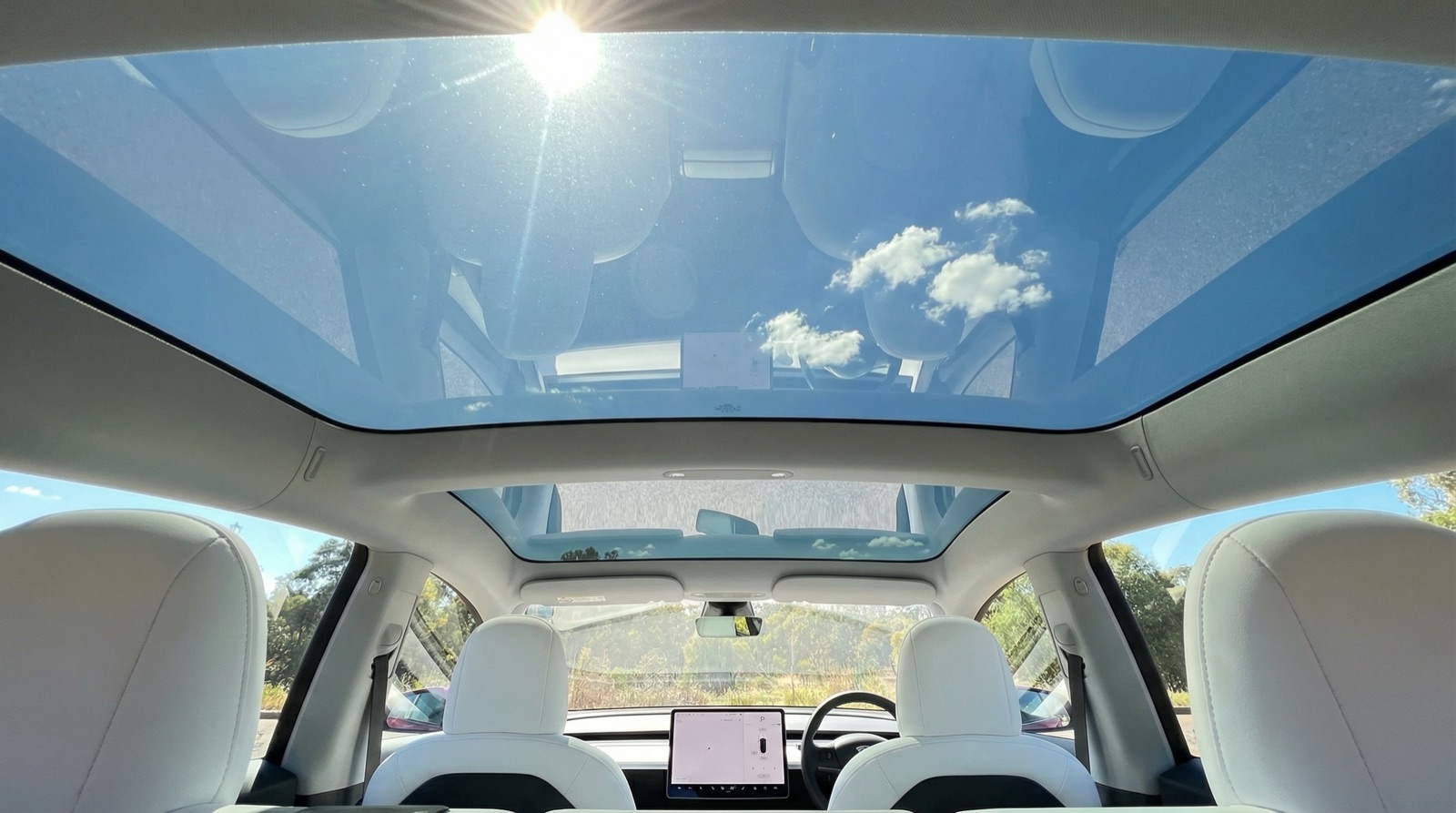
Curved geometry. The roof has compound curves — it bends in two directions simultaneously. Film doesn't naturally conform to compound curves. It needs to be heat-shrunk to shape before application, a process that requires experience with this specific vehicle. Pre-cut film templates help, but the installation technique is what determines the result.
What to expect. A full Tesla tint job — glass roof, rear windscreen, rear side windows, and front side windows — takes half a day. Drop the car off in the morning, pick it up after lunch. The glass roof alone accounts for a significant portion of the installation time.
One option is ceramic film on the roof at 70% VLT — enough to cut the heat and UV significantly while preserving the open feel that the glass roof was designed for. At 70%, you get serious infrared and UV rejection without darkening the cabin or losing the panoramic view the roof was designed for.
The other option Tesla owners try is aftermarket sun shades — mesh or fabric panels that clip onto the glass roof. They block some heat, but they also block the view, which defeats the purpose of having a glass roof in the first place. They're clunky to fit, rattle at highway speed, and they're not a permanent solution — you're clipping and unclipping them constantly. Stock availability has been patchy too, with most popular brands on backorder. They're a band-aid, not a fix.
What is increasing in popularity is a cut-to-size PPF film applied to the outside of the glass roof. It blocks UV the same way ceramic tint does, but installs from the exterior — no working inside the cabin on that massive single-piece panel. At 70% VLT, the visual result is similar to ceramic tint at the same shade, and it's a simpler, faster, and more reliable installation overall. Either option solves the heat and UV problem — ask us which makes more sense for your model.
Tesla PPF: Protecting Notoriously Soft Paint
Tesla paint is thin. The Model 3 and Model Y are reported at 80–100 microns of total paint thickness — that's the primer, base coat, and clear coat combined. Most other manufacturers sit around 120–150 microns. Some European brands exceed 200 microns.
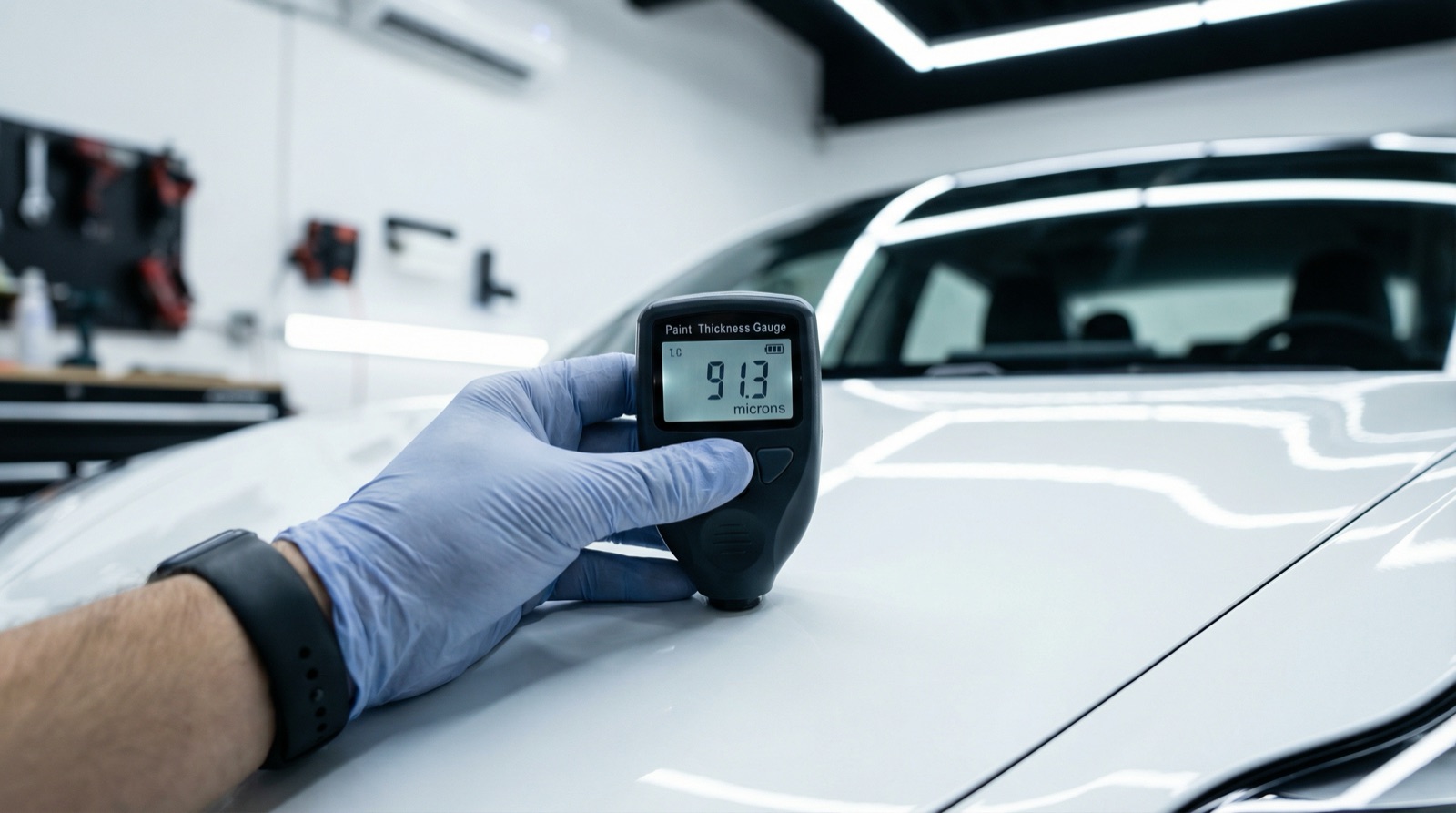
What does thinner paint mean in practice? Stone chips happen faster. Swirl marks appear more easily. The clear coat has less depth to absorb damage before the base coat is exposed.
A black Model 3 came in after six months of daily Pacific Highway commuting. The owner hadn't considered PPF because the car was new. The grill and bonnet were covered in stone chips — many had broken through the clear coat to the primer. At 90 microns total paint thickness, Tesla's paint gives up faster than almost anything else we see. Full front LLumar Valor PPF went on that afternoon.
Paint protection film is a physical barrier — 150 to 200 microns of transparent urethane film over the paint. Where ceramic coating is a chemical bond measured in single-digit microns, PPF is a sacrificial but self-healing layer that absorbs stone chips, scratches, and road debris before they reach the paint.
For Tesla owners, PPF is close to essential. The combination of thin paint and high daily use (most Teslas are daily drivers, not garaged weekend cars) means the paint takes damage faster than almost any other brand we work on. Commuters on the Pacific Highway, M1, or any of Sydney's motorways see the worst of it — stone chips from trucks and gravel are constant.
LLumar Valor is our PPF of choice. The self-healing topcoat means light scratches from car washes and fingernails disappear with heat — hot water or direct sun. The clarity is excellent, so it doesn't change the colour of the paint. Pre-cut patterns are available for every Tesla model, which means no razor blades near your paint during installation. LLumar Valor carries a 12-year manufacturer warranty.
We recommend new owners have PPF applied when the car rolls out of the showroom to lock in their cars paint in factory condition.
Tesla Paint Protection Cost
Pricing depends on what you're protecting and which Tesla model you drive.
Window tinting (ceramic film):
- Front side windows: $395+
- Rear sides + rear windscreen: $595+
- Glass roof: contact us for a quote
- Full car (all glass): contact us for a quote
PPF coverage options:
- Glass roof PPF (exterior, cut-to-size): $550+
- Full front (bonnet, bumper, guards, mirrors, headlights): $2,500+
- Full body: $6,000+
Many Tesla owners combine ceramic tint with PPF and/or ceramic coating — covering cabin heat, UV, and paint protection in one visit. Package discounts may be available on request. Contact us to discuss what suits your car.
Tesla-Specific Installation Considerations
Tesla vehicles have a few requirements that generic installers sometimes overlook.
Autopilot cameras. Tesla's vision system uses cameras mounted around the vehicle — including a forward-facing cluster behind the windscreen. Metallic tint anywhere near these cameras can degrade performance. Ceramic film doesn't interfere, but the film must be cut precisely around the camera housing to avoid any obstruction. This applies to the windscreen visor strip as well.
Sensor zones. Newer Tesla models rely on the vision system rather than ultrasonic sensors, but the principle holds — nothing should obstruct the camera housings. Film edges need to be clean and properly trimmed.
Auto-dropping windows. Tesla side windows drop slightly when the door opens and reseal when it closes. During a tint job, the glass needs to be managed carefully through this cycle. Installers unfamiliar with Teslas have shattered windows by fighting the auto-drop mechanism — there are videos online showing exactly what goes wrong. It's one of the reasons Tesla tinting is a specialist job, not something any tint shop should take on without experience with these cars.
Door handle wrapping (PPF). Tesla's flush door handles sit inside the body panel. Wrapping PPF around the door handle pocket requires a specific technique to ensure the film doesn't interfere with the handle mechanism and the edges stay sealed.
Charge port area. The charge port takes regular contact from the charging connector. A small PPF section over the charge port lid and surrounding paint prevents scratches and scuffs from daily charging.
Satin and matte finishes. If your Tesla has a matte or satin wrap, or a factory matte finish, both the window tint and PPF selections need to account for the finish — satin PPF instead of gloss, and careful masking during installation. Standard gloss PPF on a matte surface looks wrong and is difficult to remove.
Our Tesla Protection Packages
We fit Tesla vehicles at both our Hornsby and Gosford workshops. Electric vehicles — Tesla, BYD, and others — are the most common cars we see, and the Tesla installation process is dialled in. Every Model 3, Model Y, S, and X has its own template set and installation workflow.
What's included:
- Paint condition assessment before any work begins
- Ceramic window tint on all glass (including glass roof)
- PPF coverage to your chosen level — full front through to full body
- Optional ceramic coating over the PPF and remaining exposed paint for maximum protection and easier maintenance
For the full rundown on how ceramic tint compares to regular film, read our ceramic window tint guide. For NSW tint laws and VLT limits, see our darkest legal tint guide.